
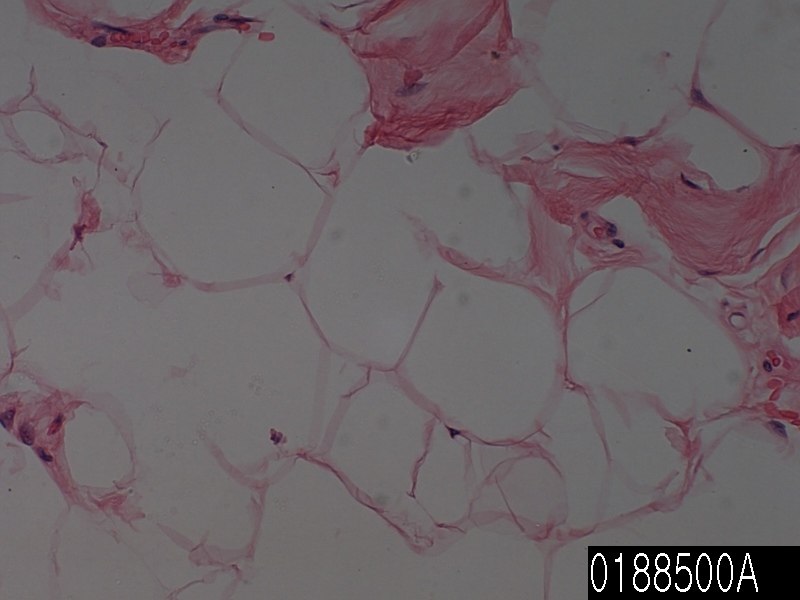
| Product name | Skin lipoma |
| Cat. No. | 0188500A |
| No. of samples | 1 |
| Description | skin, lipoma Age/Sex : 55/F |
| Price | 197 EUR |
| 260 USD | |
| 170 GBP |
Product Related Literature
Is a benign tumor consisting of (fat) lipoma, fatty tissue. This is the most common form of soft tissue tumors. Normal mobile soft to the touch, lipoma is typically painless. Lipoma of many, is the diameter of a small (less than 1 cm), but may increase in size greater than 6 cm. Lipoma, is common in adults 40-60 years of age, but it can be found in children and young adults. While saying it has not been documented convincingly still others, several sources have claimed that there is a possibility of malignant transformation occurs. Hereditary disease, a hereditary and family multiple lipomatosis such, may include the development of a lipoma, but tend to develop a lipoma option. Genetic studies in mice have shown a correlation between the development of lipoma to be (identified previously as associated with obesity gene) HMG IC gene. These studies support the data of previous human epidemiological showing the correlation of mesenchymal tumor and HMG IC. Cases where the alleged growth of lipoma, and that triggered minor injury is called “But. The tumor fat after traumatic heart” has been reported, there is room for discussion the relationship between the development of lipoma and injury .
As long as the tumor is not in restricted movement or pain, usually, there is no need for the treatment of lipoma. If you grow histopathological examination or, much larger, usually, they will be removed in cosmetic reasons to make sure that it is not more dangerous than the type of tumors such as liposarcoma such they. Actual identity of the “bump” until after the removed professionally, were tested because they do not know it, This latter point is important. Usually, lipoma, removed by simple excision. Repair is carried out under local anesthesia often, you can take less than 30 minutes. After cutting and repeating this, in most cases, to process about 1-2% of the lipoma. If lipoma is soft, liposuction has a connective tissue component almost in a further exemplary embodiment. The liposuction, usually less scarring, and the result, a large lipoma, may could lead to reproduction, fail to remove the tumor. New methods have been developed that are supposed to remove the lipoma without scarring. One of them is removed by the use of injection of the compound to induce lipolysis, such as steroids or phosphatidylcholine.
Lipoma is not life-threatening most, and subcutaneous lipoma general is not a serious condition. (However, the growth of benign, so-called “malignant by location” histologically) to become ulcer, or obstacles pain may be more dangerous than for lipoma of cases of gastrointestinal tract growth lipoma in the internal organs . Malignant transformation of lipoma is very rare in liposarcoma, malignant transformation has been described in kidney lipoma bones and in some cases, but liposarcoma most are not made from benign lesions of the existing . Some cases because not always possible to have a complete surgical resection of deep well lipoma, Deep lipoma, this is the first tumors have a tendency to be repeated from lipoma of the surface might was liposarcoma from the characteristic fine malignant being considered, are differentiated by being omitted.
Lipoma occurs in many animals, but is most common in the miniature schnauzer especially older dogs, large Labrador Retrievers, and Doberman Pinscher. Dog of overweight women are more prone especially in the development of such tumors and dogs overweight or maximum had a lipoma of at least one. In dogs, usually, lipomas occur in the upper limbs or trunk. The lipoma, it is found less frequently in pigs cows and horses, and rare cat. However, pedicle, which can cause death lipoma is necrosis, colic, ultimately, lead to twisting of the intestine in horses and confinement. Intestine is the loss of blood and handle around curls of lipoma. Lipomatosis is believed to be a hereditary disease lipoma placed in the body of plurality. The obesity Dolorosa (Dercum’s disease) is a rare condition with a lipoma painful fatigue and multiple swelling. This is observed in postmenopausal women of obesity in general. (Maderungu disease) is a condition of another, including lipomatosis benign symmetric lipomatosis. There is a possibility that women of non-alcoholic also affected but, in most cases, it occurs in middle-aged man is after many years of alcoholism.